What makes this 6-inch Ganesha eco-friendly?
This Ganpati is shaped by hand from natural clay and finished with water-soluble, non-toxic colours: no plaster of Paris, no chemical paint, no glitter, no synthetic adhesive. Placed in water, the murti returns to the soil instead of leaving residue behind in a lake or river.
Because every part of it dissolves, you can complete visarjan respectfully at home in a large tub or drum, without needing to travel to a ghat or an immersion point.
Which clay is used, and how is it different from a POP murti?
This murti is made from shadu mati , the soft riverbed clay traditionally used by murtikars across Maharashtra and Gujarat. Shadu mati holds fine detail well and breaks down completely in plain water.
The Plaster of Paris does not dissolve. A POP idol can remain in a water body for a very long time, and the paints used on it often carry heavy metals. In practical terms for your home: a 6 inch shadu mati Ganpati can be immersed in a tub in your own bathroom or balcony, while a POP idol of the same size cannot.
How do I do Ganpati sthapana at home with this murti?
Clean the space and place a wooden chowki or makhar in the north-east, covered with a fresh red or yellow cloth. Spread a few akshat on the cloth, and place the murti with both hands. Light the diya and agarbatti, and place a kalash of water with coconut and mango leaves beside Ganpati.
Take your sankalp, say aloud how many days you will keep Ganpati and complete the seva. Then offer haldi, kumkum, akshat, chandan, durva (21 blades), red flowers, and modak as naivedya, and close with the aarti and a prarthana for kshama.
Any member of the family, women included, may perform the sthapana and the daily puja. What the shastra asks for is shraddha and cleanliness, not a particular person.
What is the right muhurat, and how many days should Ganpati stay?
Sthapana is traditionally done during madhyahna kaal, roughly the midday window on Ganesh Chaturthi, when Ganpati is believed to have been born. If work or travel makes that window difficult, performing the sthapana later the same day with full shraddha is entirely acceptable.
How long Ganpati stays is a family tradition: dedh din (one and a half days), three, five, seven, or the full ten days ending on Anant Chaturdashi. Whichever you choose, take that sankalp at sthapana and complete it. From the next morning onwards, the daily routine is a simple snan, fresh flowers and durva, naivedya, and aarti twice a day.
Where should the murti be placed, and in which direction?
Place Ganpati so he faces north or east, which usually means setting up along the north-east corner, the ishaan kon, of your living room or hall. Keep the murti raised on a chowki or makhar rather than directly on the floor.
Leave enough clear space in front for the family to sit for aarti. Avoid placing the setup directly under a staircase, against a wall shared with a bathroom, or in a spot where people will walk past with footwear on.
How many Ganesha idols can be kept at home?
One murti is installed for sthapana so that the puja and the sankalp of the household stay centred on a single Ganpati. Decorative Ganesha pieces elsewhere in the house, an entrance idol, a wall panel, a dashboard murti are separate and are not counted as duplicate sthapana.
Where brothers or families share a home but run separate kitchens and separate households, each household traditionally performs its own sthapana. Where the household is one, the sthapana is one.
Can I do visarjan of a 6 inch idol at home?
Yes. A 6-inch shadu mati murti needs a larger vessel than a bucket. Use a wide tub, a bathing drum, or a deep plastic crate holding roughly 20 to 30 litres of fresh water, so the murti is fully submerged and has room to settle.
Perform the aarti and the uttar puja, ask Ganpati for kshama for any lapses in seva, and lower the murti gently with both hands. Offer durva, flowers, and a spoon of naivedya into the water as you would at a ghat, and say your Ganpati Bappa Morya. Let it rest undisturbed, do not press or break the clay by hand.
How long does it take to dissolve, and what do I do with the water?
A 6 inch murti begins softening within the first hour and usually settles fully over four to eight hours. Leaving it overnight is the easiest approach.
Once the clay has settled, pour the water along with the soft mitti into the soil of a tulsi plant, a garden bed, or large pots on your balcony. This is the quiet beauty of an eco-friendly visarjan: the clay that held your Ganpati this year goes on to hold something living. Please avoid pouring it into a drain or a kitchen sink.
Why is visarjan performed at all?
Visarjan completes what sthapana began. Ganpati is invited in as a beloved guest, offered seva for the days he stays, and then sent back to his abode with love and the prayer that he returns next year pudhchya varshi lavkar ya.
The immersion carries a gentle teaching alongside it: what is shaped from the earth returns to the earth, and what remains is the bhakti you offered during those days.
What puja samagri do I need for the days Ganpati is home?
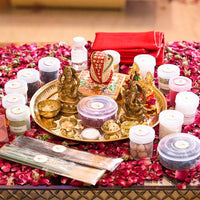
For a full sthapana you will need durva, red flowers, haldi, kumkum, akshat, chandan, agarbatti and dhoop, a ghee diya, camphor, a kalash with a coconut and mango leaves, supari, panchamrit, and modak or laddoo for daily naivedya, along with a fresh cloth for the chowki.
The room is kept clean throughout sweeping and mopping around the setup each morning is part of the seva, not a disturbance to it. If you would rather not gather everything piece by piece, our Ganesh Chaturthi puja samagri kit has it all measured out for a home puja.
What if the murti chips or breaks before visarjan?
Please do not worry. A chip or a crack in a clay murti is not an ashubh sign. Clay is soft by nature and small damage while decorating or moving the idol is common. Continue your puja as usual and complete the visarjan on the day of your sankalp.
If the murti breaks in a way that makes puja difficult, gather every piece with respect and immerse them together in water, or place them in clean soil. Never put the pieces into household waste.
 Healing Crystals
 Pooja Essentials
 Brass Home Decor
 Limited Edition
 Himalayan Salt Lamps
 Pooja Room Decor
 Evil Eye
 Urlis
Urlis
 God Idols













 +91 8010 5888 85
 orders@mypoojabox.com


